
Leakage wire monitoring for district heating companies
Pipeguard extends the life of your district heating network
A district heating network built into the ground is highly valuable infrastructure. Pipeguard monitors its leakage wires and reports moisture before a small leak becomes a large one.
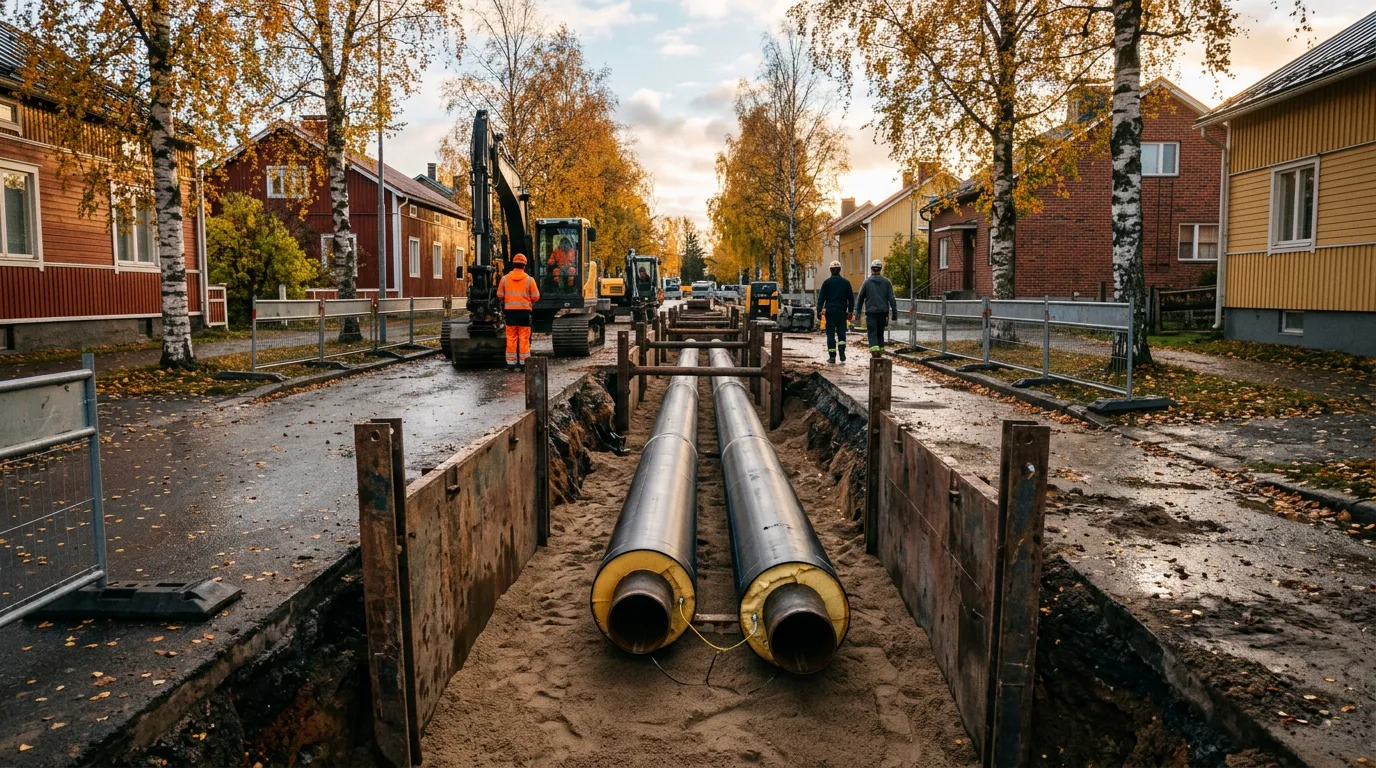 AI generated
Why leakage wire monitoring
A leak detected early extends the network’s life
By identifying leaks early and starting corrective action, the life of the network can be extended significantly.
Networks are renewed slowly
According to Finnish Energy statistics, district heating companies renewed on average 0.49% of their pipe length in 2019 (37 companies). There is variation between companies: averages by size class ranged from 0.42% to 0.71%, and the figure depends on each company’s maintenance and rehabilitation strategy.10, 11 At that rate, renewing the entire network would theoretically take about 200 years, while according to Finnish Energy the service life of a network can be well over 50 years.11
0.49%
of pipe length was renewed on average in 2019
How Pipeguard works
The pipe’s own leakage wire reveals moisture
The wire runs in the insulation
Copper leakage wires run inside the insulation of pre-insulated pipes along their whole length.
The module measures
The module measures insulation resistance and galvanic voltage as often as every hour, even on an 8 km loop.
Alarm and location
The alarm is sent by e-mail or SMS, and the pulsPG gives the distance to the fault with TDR.

Why Pipeguard
One name for leakage wire monitoring
Pipeguard monitors the pipe’s own copper leakage wires and detects moisture within a few centimetres, even on an 8 km loop.
Made for the Nordic system
Pipeguard uses the Nordic-system copper leakage wires already built into pre-insulated pipes.
For the whole network
Three modules for two, four or 1–8 pipes, including fault location with TDR.
Grows with your network
You buy only the modules you need, one or hundreds. On new pipes, warranty issues are easily detected.
Local sales
Pipeguard Finland sells Pipeguard leakage wire monitoring to Finnish district heating and cooling companies.
What Pipeguard provides
Moisture is detected early
The module detects a moisture spread of just a few centimetres around the leakage wire, even on an 8 km loop.
The source of the leak is identified
Galvanic voltage tells whether the water is district heating water or comes from outside.
Up-to-date information
Readings are available as often as every hour, and alarms are sent by e-mail or SMS. Long-term monitoring shows how moisture develops in the insulation.
The fault is located
With TDR, the pulsPG gives the distance to the fault in case of damage.
Pipeguard modules
Choose the module that suits your network
Three leakage wire modules, for two pipes, four pipes or fault location with TDR, and Sonitus for acoustic leak detection.
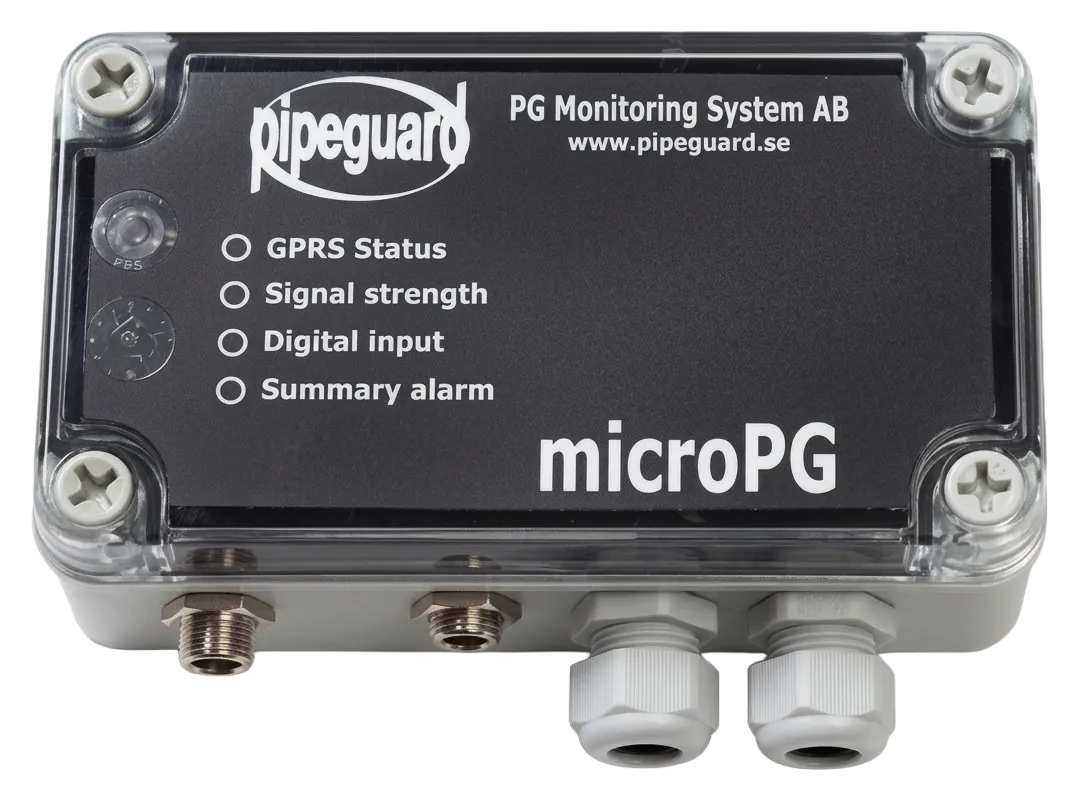 AI generatedMoisture monitoring module
microPG
Compact module for two pipes or loops.2 pipes2 × 8000 m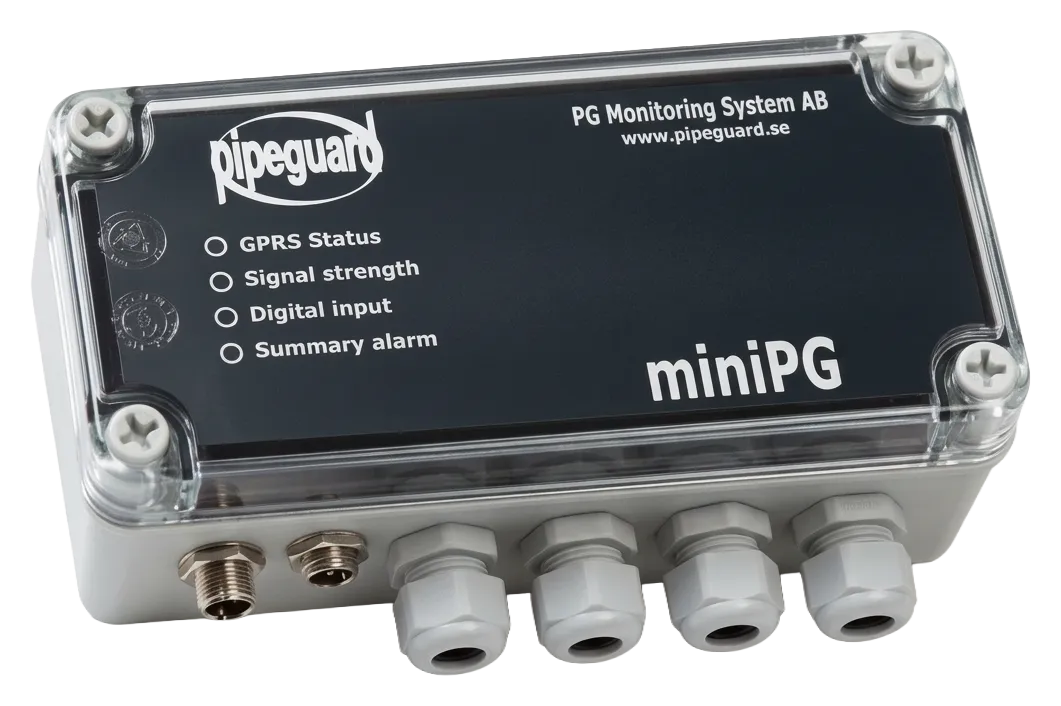 AI generatedMoisture monitoring module
miniPG
Monitors four pipes, with an LTE Cat-M1 or NB-IoT modem.4 pipes4 × 8000 m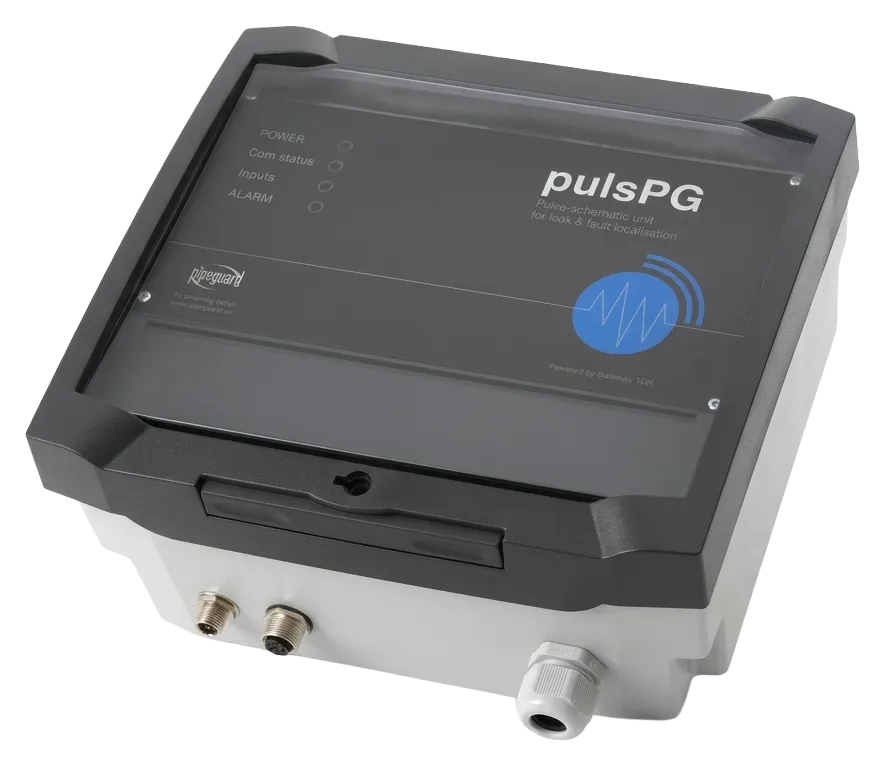 AI generatedMoisture monitoring and fault location
pulsPG
Monitors moisture and locates the fault with TDR, 1–8 pipes.1–8 pipes8000 m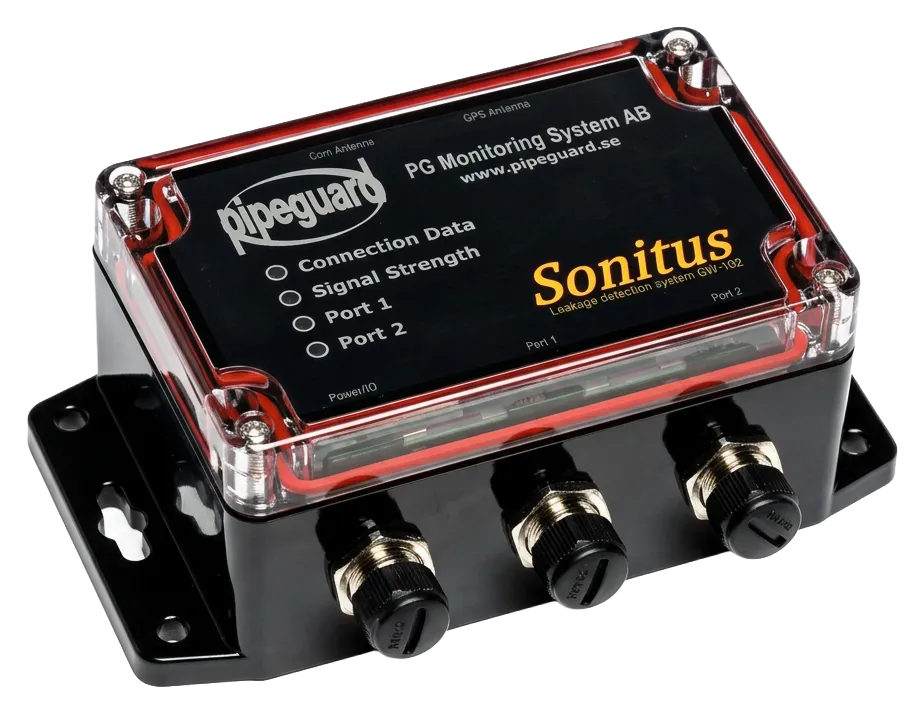 AI generatedAcoustic leak detection
Sonitus
Listens to sound and vibration in the steel pipe, 0–250 m in both directions from the sensor.0–250 m125–1875 Hz AI generated
What Pipeguard brings to a district heating company
- Active follow-up of leaking sites becomes easier.
- Routine field measurements are no longer needed, as the system takes the measurements.
- Data is available more often, as often as every hour.
- Response time is reduced.
- Time spent on measurements is freed up for other work.
- Leaks are detected in advance while they are still smaller, and they can be repaired in a planned way before they grow into large, unforeseen leaks that may cause significant damage and danger to the surroundings.
- Measurement results can be brought into the network information system, and workflows can be automated as part of daily operations.
One device, two uses
The same module monitors the leakage wires and can serve as a chamber monitoring device. Float switches can be connected to the module’s digital inputs, giving two alarm levels for water collecting at the bottom of the chamber: a warning and a critical alarm.
What industry sources say
Finnish Energy (recommendation L8/2017)
The benefits of moisture monitoring are quality control during construction and the warranty period, so that damage can be repaired while still under warranty, and monitoring during operation, which detects damage at an early stage and keeps operating and maintenance costs to a minimum.1
DBDH Hot|Cool 1/2019
An active surveillance system makes it possible to repair damage before it spreads, so that it does not affect the expected service life of the pre-insulated pipe system. Surveillance is therefore an important asset management tool. It must quickly report, among other things, weld faults, joint installation faults, product faults and excavation damage.2
DBDH Hot|Cool 4/2019
For asset management, an active surveillance system is recommended. It forms the basis for achieving at least the expected service life of the pipe system at minimum cost.3
Moisture corrodes the steel pipe
Moisture that has accumulated in the insulation through a leaking casing corrodes the surface of the steel pipe, and as corrosion progresses the pipe eventually starts to leak. Leaks typically occur in winter, when heat demand is highest. Water in the insulation can cause corrosion, and insulation that stays dry keeps its insulating properties.4, 5
Fewer field inspections
Continuous remote monitoring reduces the need for physical inspections, saving working time and inspection costs. According to Eneco in the Netherlands, the solution saves man-hours, provides data more frequently and detects digging activity so that damages can be reclaimed.6
Condition-based maintenance
Monitoring detects even minor faults, enabling preventive maintenance. Benefits cited include lower repair costs, security of supply and a longer lifetime for the pipe system.7
Example from Nottingham
In an 80 km district heating network, upgrading leak detection and targeted joint replacements extend the network’s life without replacing the pipework. The city can plan its maintenance budget, as faults are known before they develop.8
Finnish study
According to a 2024 thesis (Theseus), advanced leak detection systems reduce operational disruptions and maintenance costs and improve customer satisfaction through better service reliability.9
Sources (11)
- Finnish Energy, recommendation L8/2017: Moisture monitoring systems and wires in district heating and cooling pipes
- DBDH, HOT|COOL 1/2019, p. 13
- DBDH, HOT|COOL 4/2019, p. 10
- Vexve iSENSE District Energy Network Monitoring
- GF Urecon / LOGSTOR, Leak Detection
- Withthegrid, Leak detection (customer comments: Eneco)
- LOGSTOR Detect, Advantages
- Vital Energi, Nottingham joint replacement case study
- Tuikka, L. (2024): Leak detection systems in Finnish district heating network, Theseus
- Finnish Energy, District heating operating key figures 2019, figure 2.7 Network renewal
- Finnish Energy, recommendation KK2/2018: District heating network maintenance
Ask us or request a quote
Tell us about your network, and we will suggest the right modules and prepare a quote.